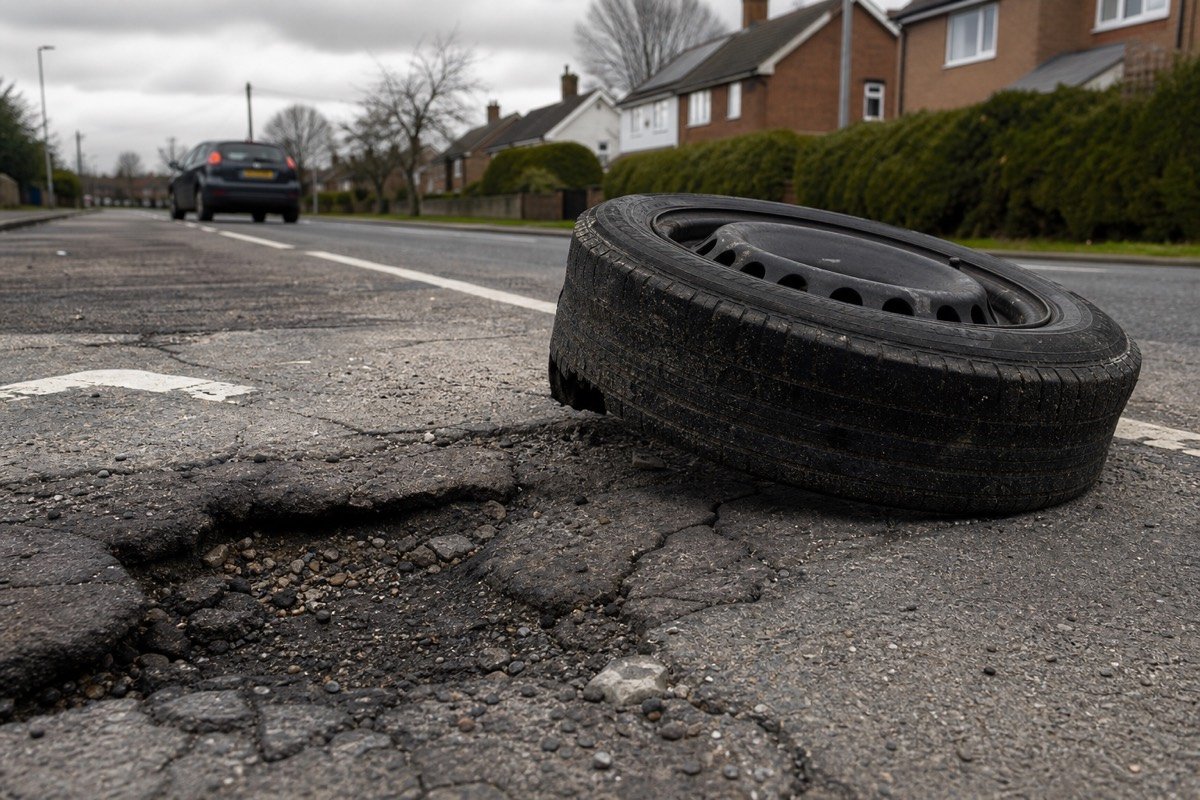
Every year, illegal or defective tyres contribute to over 1,200 reported road casualties in the UK. In 2024, police issued over 65,000 fixed penalty notices for tyre offences. The penalties are serious — up to £2,500 fine and 3 penalty points per illegal tyre, meaning you can lose your licence in one roadside check. More importantly, a tyre failure at 70mph on a motorway is one of the most dangerous situations a driver can face.
The Legal Minimum — and Why It's Not Enough
UK law requires a minimum tread depth of 1.6mm across the central three-quarters of the tyre, around the full circumference. At 1.6mm in wet conditions, your stopping distance at 50mph is nearly twice that of a tyre at 3mm tread. Most tyre safety experts recommend changing tyres at 3mm, not 1.6mm, for this reason.
Test your tread depth with a 20p coin. Insert it into the tread groove — if the outer rim of the coin is visible, your tyre is at or near the legal limit and should be replaced immediately.
Tyre Pressure: The Overlooked Killer
Under-inflation is the most common tyre problem in the UK. The AA estimates that 1 in 5 cars on UK roads has at least one significantly underinflated tyre. Under-inflated tyres:
- Increase stopping distances by up to 20%
- Reduce fuel efficiency by 3–5% (costing money at every fill-up)
- Wear unevenly, reducing tyre life by up to 30%
- Are at greater risk of blowout at motorway speeds
Check your tyre pressures monthly, and always before a long journey. The correct pressures are in your vehicle handbook and on a sticker inside the driver's door jamb — not on the tyre sidewall (that's the maximum pressure, not the recommended pressure).
Signs Your Tyres Need Attention Now
- Vibration through the steering wheel at speed: could be tyre imbalance, a bulge, or suspension issue. Get it checked.
- Car pulling to one side: uneven tyre pressure, tyre wear, or wheel alignment issue.
- Visible bulge or crack on sidewall: replace immediately — a sidewall failure is catastrophic and unpredictable.
- Uneven wear pattern: if the edges are more worn than the centre, the tyre has been chronically under-inflated. If the centre is more worn, it's been over-inflated. If one edge is worn, the wheel alignment is off.
Tyre Age: The Expiry Date Nobody Checks
Rubber degrades over time regardless of tread depth. Most manufacturers recommend replacing tyres after 5–6 years, and virtually all state 10 years as the absolute maximum. The manufacture date is stamped on the tyre sidewall as a four-digit code — the last two digits are the year (e.g., "1219" means the 12th week of 2019).
A tyre can look fine with good tread but be structurally compromised by age. Check the date on all four tyres — old tyres on a lightly-used car are a common and easily missed hazard.
Buying Replacement Tyres: What to Look For
Premium tyres (Michelin, Continental, Bridgestone, Pirelli) consistently outperform budget alternatives in independent wet-weather braking tests by 10–20%. The difference in stopping distance matters significantly in an emergency. EU tyre labels (still used in the UK) rate tyres for fuel efficiency, wet grip, and noise — look for a 'B' or higher in wet grip at minimum.
Budget tyres have their place on low-mileage, low-speed town cars. On a motorway-capable car, front axle tyres should always be premium or at least mid-range. Never mix brands or different tyre types on the same axle.
- Visual inspection of all four tyres for bulges, cracks, or embedded objects
- 20p coin tread depth test on each tyre
- Tyre pressure check (including the spare) with a quality gauge
Your tyres are the only part of your car that touches the road. A £150 tyre replacement is nothing compared to what failing to replace one can cost.