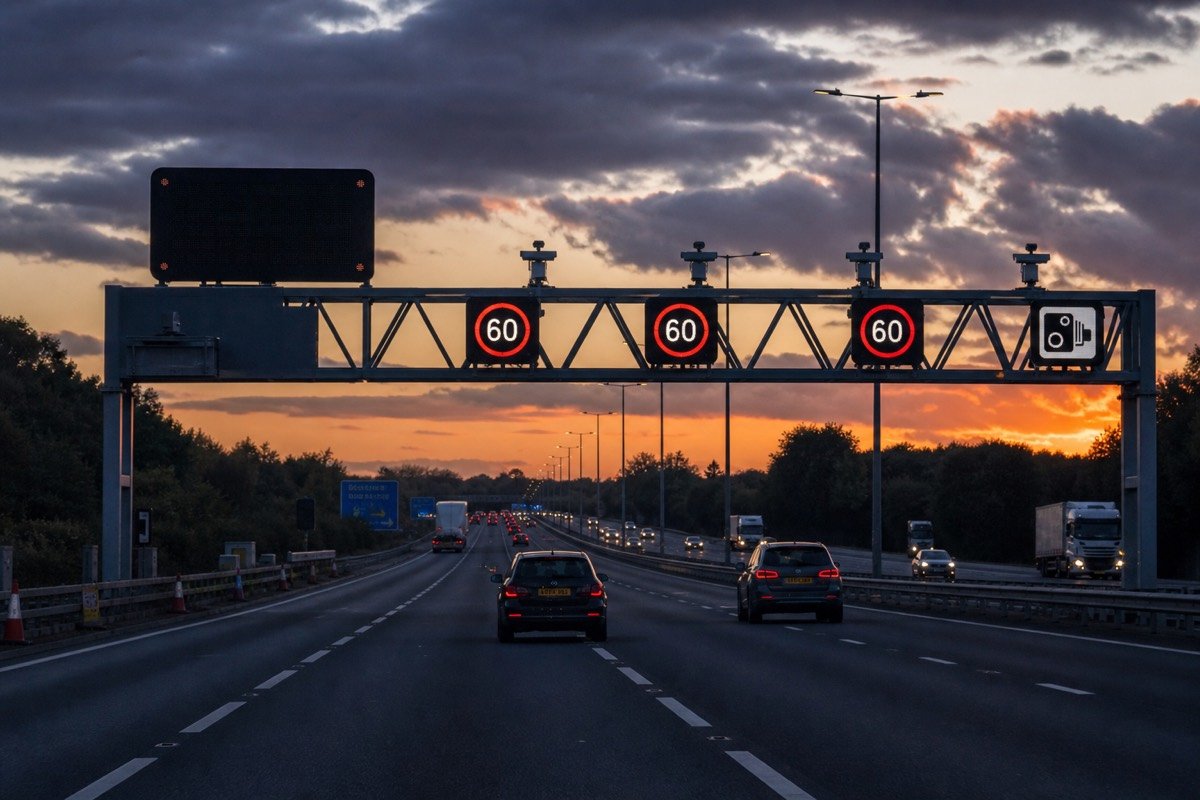
In 2023, a Transport Select Committee report described all-lane running smart motorways as "an unacceptable risk to life." In 2024, the government announced a pause on new all-lane running schemes pending a safety review. In 2025, National Highways published data claiming smart motorways are statistically safer per mile than conventional motorways. The argument continues. But there are currently over 400 miles of smart motorway on UK roads, and drivers need to know how to navigate them.
What Is a Smart Motorway?
Smart motorways come in three varieties:
- Controlled motorway: Keeps the hard shoulder but uses variable speed limits displayed on overhead gantries. The safest type.
- Dynamic hard shoulder: The hard shoulder is opened as a running lane during peak hours, controlled by gantry signs. A red X means the lane is closed.
- All Lane Running (ALR): The hard shoulder has been permanently converted into a traffic lane. There is no hard shoulder. This is the most controversial type.
The Core Safety Problem
On a conventional motorway, if your car breaks down or suffers a tyre blowout, you pull onto the hard shoulder — a protected space away from live traffic. On an ALR smart motorway, there is no such refuge. You are stranded in a live lane. The system relies on stopped vehicle detection (SVD) cameras and overhead gantry signs closing the lane quickly enough to protect you.
Investigations — including a BBC Panorama documentary and the Transport Committee's inquiry — found that SVD cameras were missing on long stretches, response times were too slow, and the emergency refuge areas (ERAs) were spaced too far apart, sometimes over a mile.
What You Should Do if You Break Down
On an ALR smart motorway:
- If you can move, get to the nearest ERA (orange SOS signs on the left). Never stop on the white line marking the old hard shoulder — it's a live lane.
- If you cannot move, switch on your hazard lights immediately, stay in your car with your seatbelt on if it's safe to do so, call 999, and tell them you are on a smart motorway with your exact location (use the marker posts every 100m for reference).
- If you must exit the vehicle, exit via the nearside (left) door only, climb the verge or barrier, and stay well back. Never stand between your car and live traffic.
What the Overhead Signs Mean
- Red X: Lane closed — mandatory. Driving in a lane showing a red X is a moving traffic offence and carries a £100 fine and 3 penalty points. Cameras enforce it automatically.
- Blank gantry panel: National speed limit applies (70mph).
- Speed in red circle: Variable mandatory speed limit — enforce as strictly as a static sign.
- Amber warning signs: Hazard ahead — reduce speed and be prepared to stop.
How to Know If You're on a Smart Motorway
Overhead gantry signs above each lane, rather than just on the central reservation, are the clearest indicator. You'll also see blue ERA signs on the left-hand verge. The presence of a continuous white lane line where the hard shoulder used to be indicates ALR operation.
The Retrofit Programme
National Highways committed in 2022 to installing SVD technology across all existing ALR smart motorways by the end of 2025. The majority of this programme has been completed, improving detection speed significantly. However, ERA spacing remains a legitimate concern on some older sections.
Smart motorways aren't going away. Knowing how they work and what the signs mean is as fundamental as knowing the Highway Code.