Most UK drivers passed their test years or decades ago and haven't revisited the Highway Code since. But the code is a living document — updated regularly — and ignorance of its changes doesn't protect you from prosecution. Here are the key rules and legislation currently in force that many drivers aren't aware of.
The Hierarchy of Road Users (Highway Code, 2022–2026)
The 2022 Highway Code update introduced a formal hierarchy: pedestrians first, then cyclists, then horse riders, then motorcyclists, then cars, then larger vehicles. This has direct practical consequences:
- Drivers must give way to pedestrians at junctions — including when turning into a side road, even if the pedestrian hasn't yet stepped into the road.
- Cyclists can ride in the middle of a lane in slower-moving traffic or on narrow roads — and this is now explicitly supported by the code.
- When overtaking cyclists, drivers must allow a minimum of 1.5 metres at speeds up to 30mph and more at higher speeds.
Many of these rules changed in 2022, but enforcement and public awareness have caught up only gradually.
Mobile Phone Law: Expanded in 2022, Still Catching Drivers Out
Since March 2022, using a handheld phone while driving is illegal for virtually any use — not just calls and texts. Scrolling social media, taking photos, and even checking a static map at traffic lights is now illegal. Penalty: £200 fixed penalty and 6 points. For new drivers (licence held less than 2 years), 6 points means an automatic revocation.
The only legal use is a hands-free device with the phone in a proper mount. You may not handle the phone to input a destination while the car is moving. Set the destination before you move off.
Clean Air Zones: Expanding to More UK Cities
Birmingham, Bath, Bradford, Portsmouth, Bristol, and Greater Manchester all operate Clean Air Zones with daily charges for non-compliant vehicles. As of 2026, several more zones are in development. Check your vehicle's Euro emission standard via the DVLA before driving into any major UK city centre. Fines for entering without paying are typically £60–£120, rising if unpaid.
Compliance checkers are available at gov.uk/check-clean-air-zone-charge.
Pavement Parking
England is moving toward a national ban on pavement parking, following Scotland's lead (Scotland banned it in 2023). In England, local authorities are being given powers to enforce pavement parking bans without the need for specific Traffic Regulation Orders. If your council has activated these powers, parking with any wheel on the pavement is a £70 PCN. Check your local council's website for current enforcement status.
Updated Speed Awareness Course Rules
You can only attend a speed awareness course once every three years for the same type of offence. From 2025, NPCC guidance updated the threshold: courses are typically offered for speeds up to 10% + 9mph over the limit. Exceeding this threshold means a fixed penalty or court. A second offence within three years results in points regardless.
Tailgating: Now Actively Enforced
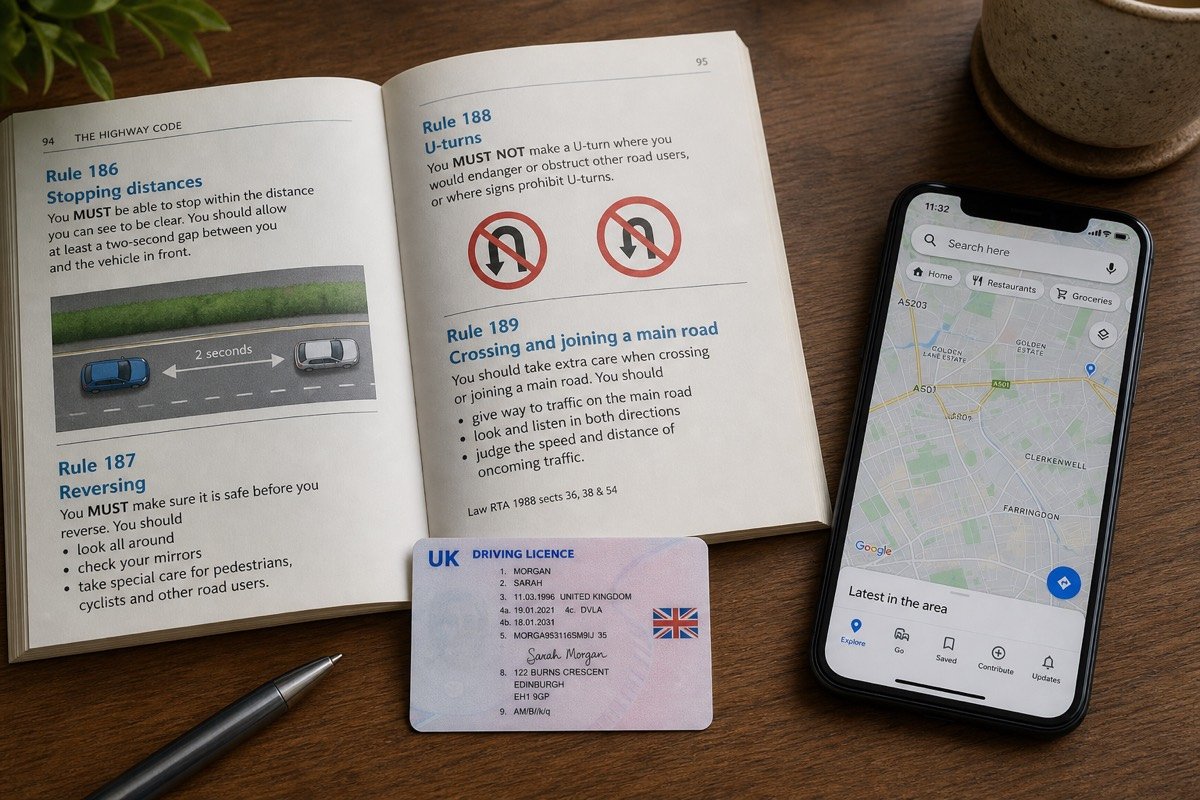
Operation Tramline uses HGV cab cameras to catch tailgating, phone use, and unsafe lane changes from an elevated angle. Unmarked police vehicles on motorways also target tailgating specifically. The Highway Code rule 126 requires a minimum two-second gap in normal conditions, doubled in wet weather. Tailgating can result in a £100 fixed penalty and 3 points.
Autonomous Vehicle Rules (Effective 2026)
The Automated Vehicles Act 2024 came into force, establishing the legal framework for self-driving vehicles on UK roads. Crucially, when a vehicle is operating in an approved "automated mode," the manufacturer — not the driver — bears legal liability for any incidents. However, the driver remains responsible when they take back control. This affects a small but growing number of vehicles and is set to expand significantly.
The safest approach is simple: treat every update to the Highway Code as an amendment to the law, because that's exactly what it is.