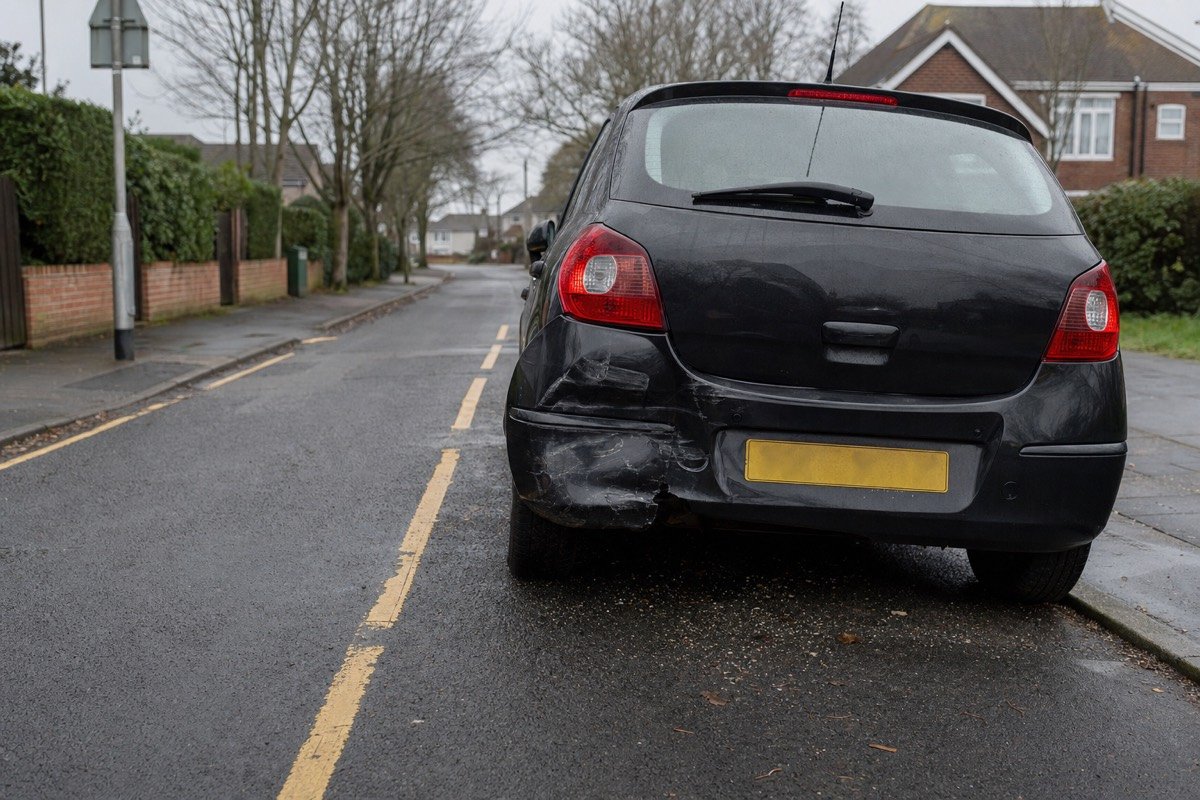
You come back to your parked car and find a dent, scratched paintwork, or a smashed mirror — and no note. Or it happens in real time: another vehicle clips yours and doesn't stop. In either case, leaving the scene of an accident is a criminal offence under the Road Traffic Act 1988. The driver who fled has committed a crime. You haven't.
The question is: what do you do now?
The First 30 Minutes: What Matters Most
Speed is critical. The more time passes, the harder it becomes to trace the driver, gather CCTV, or find witnesses.
- Don't move your car if you witnessed the collision — preserve the scene.
- Call 999 if anyone is injured. Otherwise, call 101 (non-emergency police) to report the incident. You'll receive a crime reference number — keep it.
- Photograph everything: the damage to your car, skid marks, debris, and the exact location.
- Note the time and look for CCTV cameras on nearby buildings, lamp posts, or businesses. Note their locations so police can request the footage quickly.
- Ask bystanders if anyone saw what happened. Even a partial registration ("I think it started with EK23...") can be enough for police to trace a vehicle.
Reporting to Police: Is It Worth It?
Yes — always. You must report a hit-and-run to the police within 24 hours if you weren't present (e.g., parked car). If you were present, you should report immediately. The crime reference number is required for any insurance claim involving an untraced driver.
Police statistics show that around 20% of reported hit-and-runs result in the driver being identified, thanks largely to CCTV and dashcam footage submitted by the public.
Claiming on Insurance: What Happens to Your Premium
If the other driver is traced and found to be at fault, their insurer pays. Your premium is unaffected.
If the driver is never found, you have two routes:
- Claim on your own comprehensive policy. Your insurer will pay for repairs minus your excess. This will likely affect your no-claims bonus — check your policy terms.
- Claim via the Motor Insurers' Bureau (MIB). The MIB compensates victims of uninsured and untraced drivers. You don't need to be at fault and it doesn't affect your no-claims. You'll need the police crime reference number.
The MIB Route: How It Works
The Motor Insurers' Bureau runs a scheme called the Untraced Drivers Agreement. To be eligible:
- The incident must have been reported to police within 14 days (5 days for personal injury)
- You must cooperate with any MIB investigation
- There must be some physical evidence (damage, witness, dashcam footage)
The MIB pays out for vehicle damage, personal injury, and even hire car costs in some cases. Claims are assessed by the MIB's own team, not your insurer, so it doesn't touch your no-claims bonus.
How a Dashcam Changes Everything
A rear dashcam recording the moment of impact — or a parked mode dashcam active while your car is stationary — provides timestamp-verified video evidence of the collision and, often, a clear view of the offending vehicle's registration plate. This footage can be shared directly with police and the MIB, dramatically improving the chance of identifying the driver. In multiple documented UK cases, dashcam parked mode footage has led to successful prosecutions of hit-and-run drivers weeks after the event.
If the Driver Left a Note
Some drivers panic and leave a note — but leave false details. Always verify: check that the registration matches the name given, and that the insurance details are genuine. You can check a vehicle's registered keeper via a DVLA online check and verify insurance via the Motor Insurance Database at askMID.com.
A hit-and-run is frustrating and costly. But between the MIB, your comprehensive insurer, and the police, you have more routes to resolution than most drivers realise — and the driver who fled has committed a criminal offence that carries up to six months in prison and a mandatory driving ban.